simple site builder

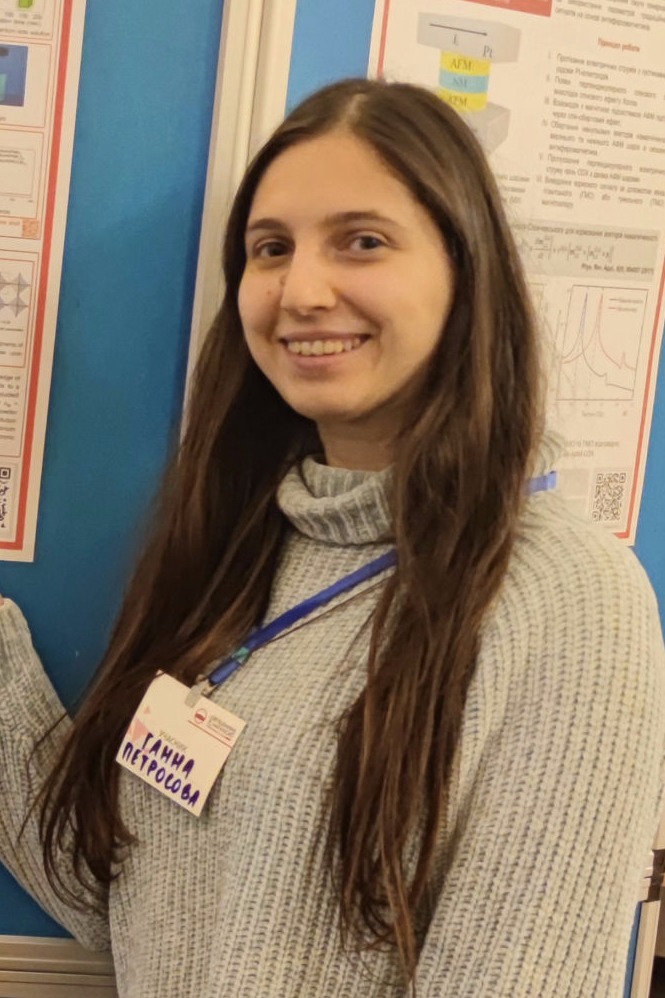
Dr. Hanna R. Petrosova
PhD in Chemistry
Junior researcher at the Department of Chemistry, Taras Shevchenko National University of Kyiv 

2025 – present – Research Assistant, Department of Physical Chemistry, Faculty of Chemistry, Taras Shevchenko National University of Kyiv.
2024 – 2025 – Engineer (Category I), Faculty of Chemistry, Taras Shevchenko National University of Kyiv.
2021 – 2025 – PhD Student, Taras Shevchenko National University of Kyiv (Faculty of Chemistry, Department of Physical Chemistry). PhD thesis: “Semiconductor materials based on hybrid 3D perovskites with aziridinium cation”, defended in 2025. Supervisor: Academician, Dr. Sci. (Chem.), Prof. Igor O. Fritsky.
2015 – 2021 – Student, Taras Shevchenko National University of Kyiv (Faculty of Chemistry, Department of Physical Chemistry). Master’s thesis: “Influence of support treatment on the catalytic properties of the Co–Fe catalyst system deposited on ultradispersed diamonds in the CO2 methanation reaction” (Supervisor: PhD, Assoc. Prof. Snizhana V. Gaidai). 

SCOPUS: 57674310300
ORCID: 0009-0008-8649-8212
WoS: IAM-4706-2023

International Research Internships 

Hanna Petrosova has completed research internships at leading European laboratories:

• 2022 – Faculty of Chemistry, University of Wrocław (Wrocław, Poland).

• 2023 – “Petru Poni” Institute of Macromolecular Chemistry (Iași, Romania).

• 2023 – Faculty of Chemistry, University of Cologne (Cologne, Germany).

• 2025 – “Petru Poni” Institute of Macromolecular Chemistry (Iași, Romania).

Research Interests 

Hanna Petrosova’s research is focused on the fields of chemistry and materials science, with particular emphasis on the development of new functional materials based on hybrid halide perovskites. The core of my work involves the synthesis of new compounds, the investigation of structural features of emerging materials, and the study of their semiconductor properties.

Main research directions:

• Synthesis of new hybrid perovskites. Development of synthetic approaches for obtaining 3D perovskites incorporating various organic cations and metal cations. Design of new materials with tailored properties through controlled variation of perovskite composition.

• Characterization of synthesized compounds. Determination of crystal structures, optical characteristics, and physicochemical properties using single-crystal and powder X-ray diffraction, UV–Vis spectroscopy, photoluminescence, and other modern methods of analysis.

• Application of the obtained semiconductor materials. Fabrication and investigation of thin films of the obtained hybrid perovskites; exploration of hybrid perovskites as catalytic materials.